
Home / Projects / China Merchants Shekou Folding Wall
Eight columns that open a wall into a reveal
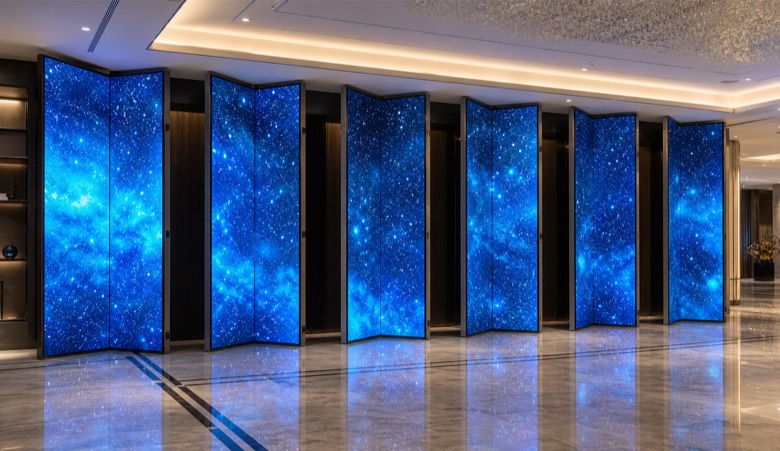
A folding and opening LED wall at China Merchants Shekou in Shenzhen — eight display columns that travel apart to reveal what is behind them, then close back into one continuous canvas.
Project at a glance
- Delivered
- June 2023
- Location
- Shenzhen, China
- Client setting
- China Merchants Shekou
- System
- Multi-screen open / close display
- Columns
- 8 display columns
- Motion
- Motorised travel along rails
- Environment
- Indoor
The brief: a wall that has to disappear on cue
An opening LED wall does two jobs that pull against each other. Closed, it has to read as a single uninterrupted display — no visible column seams, no hint that it is eight separate assemblies. Open, it has to clear the space completely and predictably, on cue, without the audience watching a mechanism struggle.
Most of the engineering effort goes into the first requirement. Anyone can move eight columns apart; making them close back into a surface that looks like it was never divided is the harder problem.
What was engineered
Rail layout and travel
Multiple displays open and close along straight or curved rails to reveal content or form a continuous canvas. Rail geometry is set by the opening width the space needs and by where the columns can park when open — the parked position is a real constraint, not an afterthought.
Independent path control with anti-collision logic
Each column is independently driven, which is what allows staged openings rather than a single symmetrical split. Independent paths also make collision a real possibility, so anti-collision logic sits in the control layer rather than being handled by mechanical stops alone.
The closed-state seam
Column alignment in the closed position determines whether the wall reads as one display. Repeatable end positions matter here for the same reason they matter on any staged reveal: the wall closes many times over its life, and it has to close identically every time.
Control integration
The motion system supports manual operation, motion synchronised with media, and TCP or UDP control integration — so the wall can be run by a venue operator or driven directly by the content system depending on how the space is programmed.
| Design driver | What it determines |
|---|---|
| Opening width required | Rail length and where columns park when open |
| Closed-state appearance | Column alignment tolerance and end-position repeatability |
| Independent column paths | Anti-collision logic in the control layer |
| Operating model | Manual, media-synchronised or TCP / UDP integration |
Why an opening wall instead of a lifting one
Vertical motion needs headroom and a place for the screen to go. Horizontal opening needs width and parking space at the sides. Which one is right is almost always decided by the building rather than by preference — and in an interior with a fixed ceiling, opening sideways is frequently the only motion available.
Delivery
The rail, servo, safety and interface package is configured around the project rather than selected from a fixed catalogue, and behaviour is reviewed before the system leaves the factory.
Questions this project usually raises
Can the columns open in sequence rather than all together?
Yes. Each column is independently driven with its own path, so staged and asymmetric openings are possible. Independent paths are also why anti-collision logic sits in the control layer rather than relying on mechanical limits alone.
Will the seams show when the wall is closed?
Closed-state appearance is treated as a primary requirement, not a tolerance discovered at commissioning. Column alignment and repeatable end positions are what decide whether the wall reads as one continuous display.
Can our media server drive the motion?
The system supports manual operation, motion synchronised with media, and TCP or UDP control integration, so the wall can be operated by venue staff or driven directly by the content system.
Related
Planning an opening or folding wall?
Share the opening width, closed canvas size, parking space at the sides and how you want it operated. Engineering replies within 8 business hours.
Start engineering review