
Home / Projects / Beijing Workers Stadium Kinetic Ceiling
A servo-hoisted ceiling that moves with the room
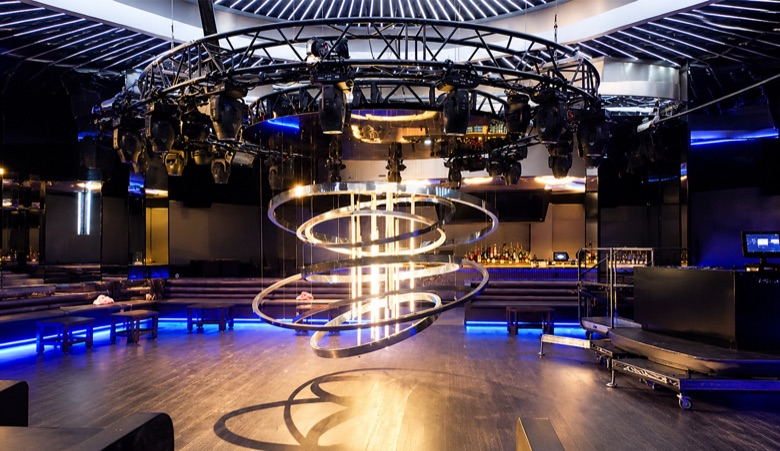
A kinetic ceiling above a nightlife venue at Beijing Workers Stadium — suspended elements driven by servo hoists, programmed to change the height and shape of the room through the night.
Project at a glance
- Delivered
- October 2023
- Location
- Beijing Workers Stadium, China
- Setting
- Nightlife venue
- System
- Servo hoist kinetic ceiling
- Motion
- Programmed vertical travel
- Configuration
- Multiple lift points
- Environment
- Indoor, suspended
The brief: change the room, not just the lighting
A venue can change its mood with light and sound, but it cannot change its volume. A kinetic ceiling can — lowering elements to compress the room and lift the energy, raising them to open it out again. The effect works because the audience feels the architecture move, which no lighting cue reproduces.
It also means suspending moving mass directly above a room full of people, which puts the safety case at the centre of the project rather than at the end of it.
What was engineered
Lift points and load classes
The first decision on any hoist project is the number of lift points, the travel required and whether motion is synchronised or independently programmed. Those three answers determine the load class before any other choice can be made. The platform covers 500, 1000 and 2000 kg rated load classes, with a reference lift height of 25 m and an operating speed of 4.5 m/min.
Synchronised versus independent motion
A ceiling that drops as one plane is a different control problem from a ceiling whose elements move independently to form waves and tilts. Independent programming is what makes the ceiling expressive; it is also what makes synchronisation accuracy matter, because uneven travel across lift points reads immediately as a fault.
Safety planning
Entertainment chain hoist safety planning is a discipline of its own, and it is not an accessory to the mechanical design — secondary retention, load monitoring, limits and the operating procedure are specified alongside the lifting route from the beginning.
Environment
The reference configuration is rated IP54, with chain diameters of 6, 8 or 10 mm according to load class. A nightlife venue is an indoor environment but not a clean one — haze, heat and continuous operating hours all sit on the specification.
| Platform reference value | Figure |
|---|---|
| Rated load classes | 500 / 1000 / 2000 kg |
| Reference lift height | 25 m |
| Operating speed | 4.5 m/min |
| Protection rating | IP54 |
| Chain diameter | 6 / 8 / 10 mm by load class |
| Hoist families | Q1, Q2+, Q3, JQ-A |
Published platform reference configurations. Final hoist and control package are confirmed through engineering review against the actual rigging structure.
Delivery
The lifting route is defined from control down to the suspended load before hardware is fixed. Above an occupied room there is no acceptable version of discovering a load path problem during commissioning.
Questions this project usually raises
How is a kinetic ceiling made safe above an audience?
Entertainment chain hoist safety planning is specified alongside the lifting route rather than added afterwards — secondary retention, load monitoring, travel limits and the operating procedure are part of the same engineering package as the hoists themselves.
Can each element move independently?
Yes. Motion can be synchronised across all lift points or programmed independently per point. Independent programming is what allows waves and tilts, and it is also why synchronisation accuracy becomes a visible requirement.
What decides the load class?
The number of lift points, the travel required and the suspended weight per point. The platform covers 500, 1000 and 2000 kg classes; the final selection is confirmed through engineering review against the venue’s rigging structure.
Related
Planning a kinetic ceiling or suspended installation?
Share the number of lift points, travel, suspended weight per point and the rigging structure available. Engineering replies within 8 business hours.
Start engineering review