
Home / Projects / Leading Phone Brand Campus
Eight rotating layers, one changing brand landmark
A double-sided arc rotating LED tower built for the corporate campus of a leading phone brand — eight independently driven layers that hold a composition rather than simply spin.
Project at a glance
- Delivered
- October 2025
- Location
- Dongguan, China
- Setting
- Corporate campus lobby
- System
- Indoor rotating LED tower
- Layers
- 8, independently driven
- Layer format
- Double-sided arc
- Motion
- Independent rotation, programmed sequences
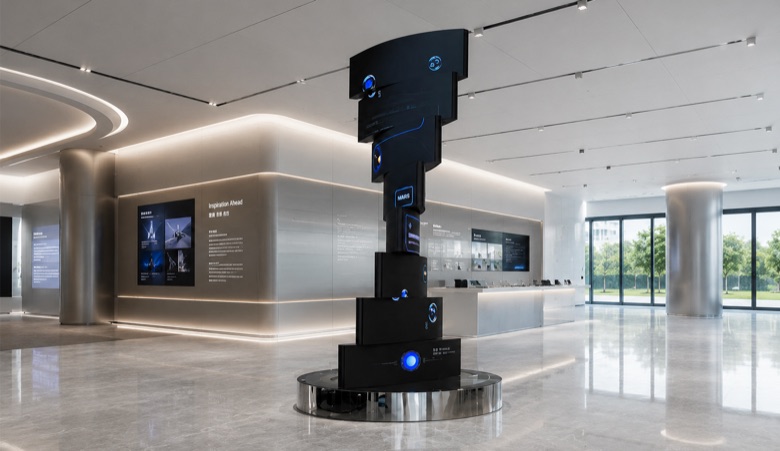
The brief: a landmark that had to be a screen and a sculpture
A corporate campus lobby is a difficult place to put a display. People approach from several directions, they pass through rather than sit down, and the object is on show even when nothing is playing. A flat LED wall solves the content problem and fails the architecture problem — switched off, it is a black rectangle.
The requirement here was for something that reads as a designed object at rest and as a display in motion. That pushed the project away from a screen with a mount and towards a rotating structure that happens to carry display.
What was engineered
The work divides into four connected problems, and none of them can be solved on its own.
The rotating assembly
Each layer sits on its own driven axis. On the curved format this platform uses 1280 × 320 mm double-sided layers on servo drive, with six to twelve layers as the standard range. Eight was chosen here for the ceiling height and the sightlines through the lobby.
Double-sided display
Every layer carries display on both faces, so there is no dead side as it turns. In a lobby with multiple approach routes that matters more than raw area — it removes the need to pick a primary viewing direction and then design around everyone who arrives from somewhere else.
The control layer
Direction, speed and hold position are programmed per layer, and the control layer synchronises mechanical position with on-screen content. That is the difference between a tower that spins and a tower that performs: waves, offsets and staggered reveals become repeatable sequences rather than ambient movement.
Service access
The display layers are detachable. Load path, cable routing and the maintenance route were treated as design constraints from the beginning — on a rotating assembly, access designed in afterwards usually means access that does not exist.
| Constraint | How it shaped the build |
|---|---|
| Approach routes | Double-sided layers, no primary viewing direction |
| Ceiling height | Eight layers rather than the twelve-layer maximum |
| Content timing | Layer position and media cues planned together, not sequentially |
| Maintenance | Detachable layers, access route fixed before the structure |
Why the composition matters more than the rotation
The tower’s useful states are not “moving” and “still”. They are aligned, where the layers form one continuous curved surface and the tower behaves like a screen; offset, where the layers step into a spiral and the tower behaves like a sculpture; and sequenced, where a change travels up or down the structure and the two readings resolve into each other.
Getting between those states cleanly is a control problem, not a mechanical one. It is also where most kinetic installations fall down — the motion is impressive once and then becomes wallpaper, because nothing is choreographed against the content.
Delivery
Mechanical and control behaviour is reviewed and signed off in the factory before packing. For a rotating assembly this is not a formality: commissioning a multi-axis structure on site, in a finished lobby, with a deadline, is the expensive way to discover a problem.
Questions this project usually raises
Why rotate the layers independently instead of turning the whole tower?
A single rotating body can only spin. Independent layers let the tower hold a state — aligned into one continuous surface, offset into a stepped spiral, or sequenced so a reveal travels up or down the structure. The composition becomes programmable rather than kinetic decoration.
What does double-sided mean for a rotating LED tower?
Each layer carries display on both faces, so there is no dead side as the layer turns. It doubles the display area per layer and removes the need to choose a single viewing direction — which matters in a lobby where people approach from several routes.
How is maintenance handled on a rotating tower?
The display layers are detachable, and service access is treated as a design constraint from the start rather than solved afterwards. Layer removal, cable routing and the access route are engineered together with the rotating assembly.
Can we specify a different layer count?
Six to twelve layers is the standard range for this platform. Beyond twelve, the project moves from standard configuration to engineered-to-order, because inertia, shaft loading and service access change the structural case.
Related
- Multi-layer rotating LED screen — the platform this project was built on
- Outdoor rotating landmark, Xi’an — the same motion outdoors, where wind load joins the calculation
- LED wall calculator — size a surface and see the load it puts on the structure
- All seven motion platforms
Planning a rotating installation?
Share the screen format, layer count, site height and the motion reference you have in mind. Engineering replies within 8 business hours.
Start engineering review